 quoneon
Registration estimates a spatial relationship between images. A registration procedure combines a transform, image-comparison metric, optimizer, and interpolator.
Mathematical principle
This notation maps a fixed-image location to the moving image for sampling. Record transform direction explicitly.
Input definitions
| Item | Meaning |
|---|---|
| Fixed image | Reference image and physical geometry. |
| Moving image | Image to relate to the reference. |
| Initialization | Starting alignment and transform settings. |
Analysis choices
| Item | Meaning |
|---|---|
| Transform family | Determines permitted spatial changes. |
| Similarity metric | Defines how image correspondence is scored. |
| Optimization | Specify settings and stopping conditions. |
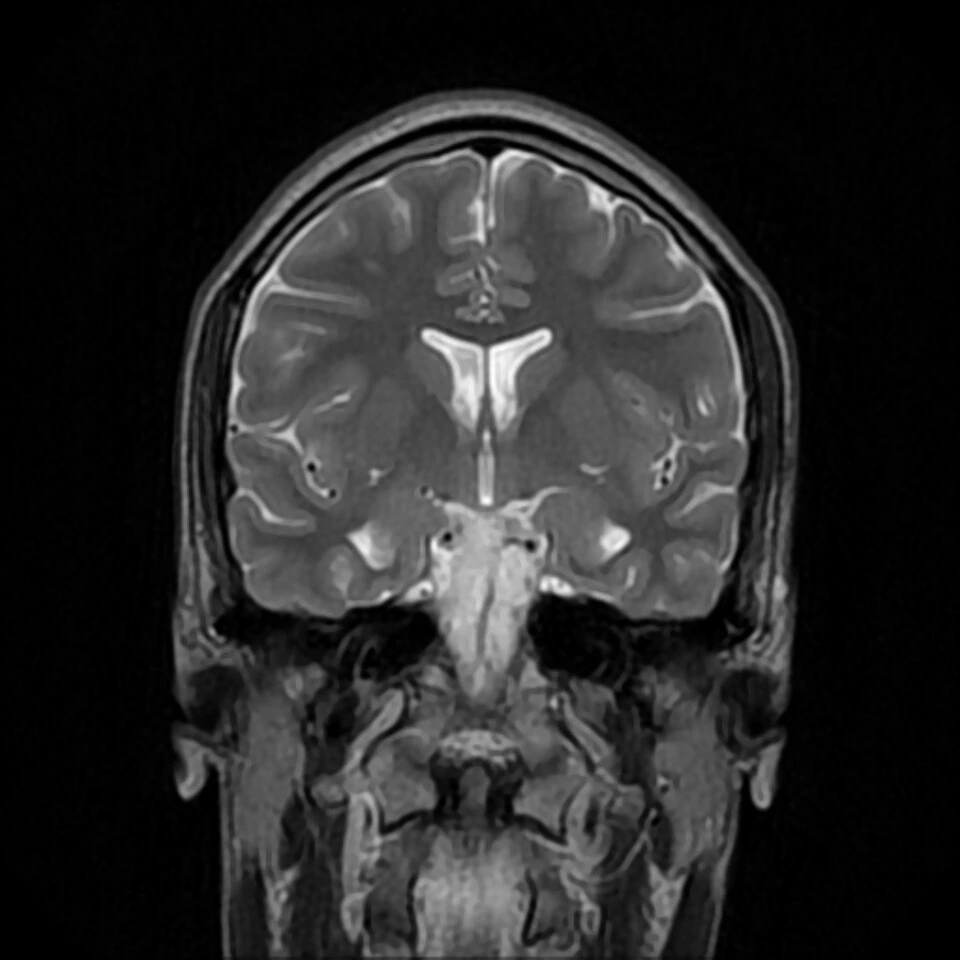
An anatomical reference image
Interpretation
Review the resulting alignment as well as the optimizer’s score. Interpolation changes sampled values, while transform choice limits the alignments that can be represented. Preserve physical coordinates when relating regions across modalities.
Scientific references
Related major models
From the principle to a scoped workflow
Keep physical geometry, transform direction and resampling separate from how an aligned image is scaled for display. A visually plausible overlay is useful for inspection but does not by itself quantify registration accuracy.
| Learning path | What to inspect and what it establishes |
|---|---|
| Aligned source values and normalized fusion displays | The multimodal guide distinguishes registered source-scale arrays, normalized display results, selected planes/frames and geometry-dependent exports. Evidence scope: It is a fusion input/display/export contract guide, not independent validation of a standalone registration method or every fusion route. |
| Prepare a spatial comparison | Retain corresponding images, acquisition context, spatial metadata and the regions intended for comparison before interpreting quantitative differences. Evidence scope: The general preparation lesson does not establish physical correspondence or the accuracy of a transform on a particular dataset. |